Heidi Ulrich
An Interview with the Windsurfing Speed World Record Holder
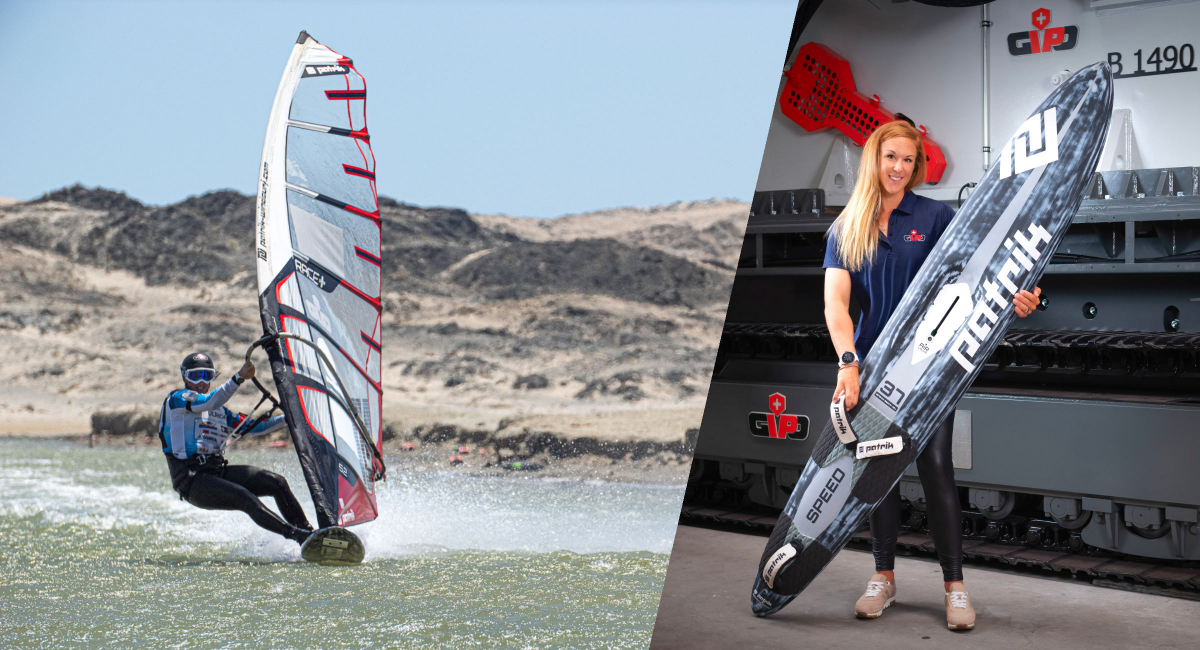
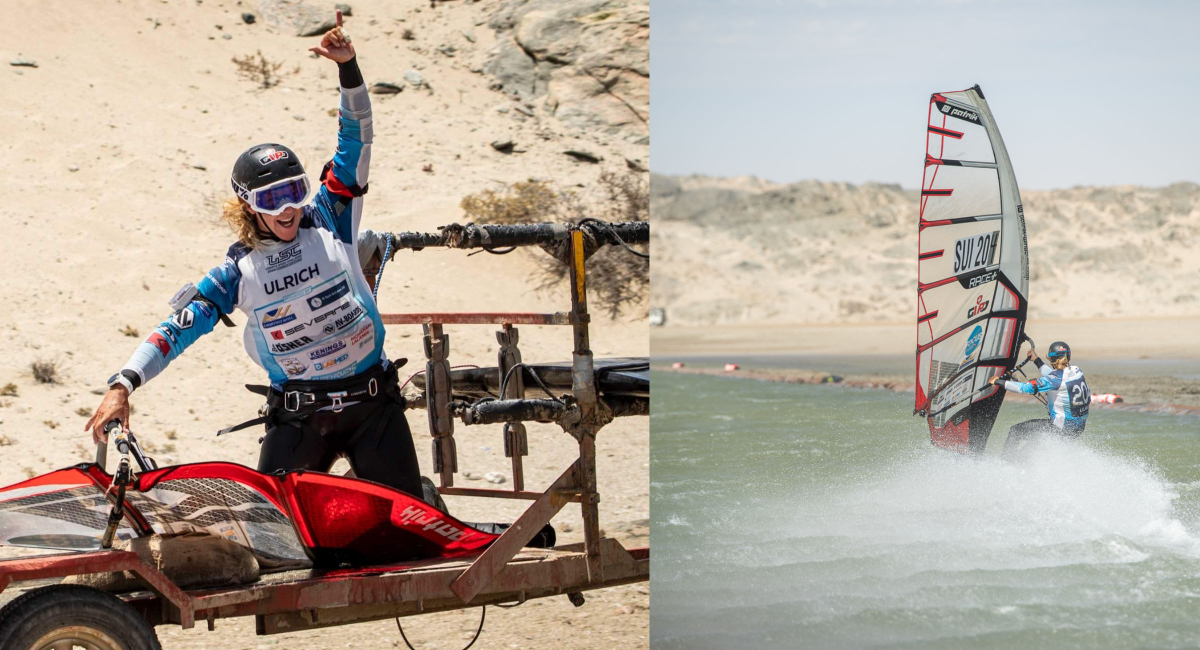
On November 25, 2022, Swiss windsurfer Heidi Ulrich set a new women’s world speed record of 47.06 knots (87.16 km/h) on the man-made speed channel in Namibia. In this interview, she discusses, among other things, the role of equipment in speed surfing, offers tips for anyone who wants to try windsurfing faster, and explains the slingshot maneuver.
You set a new world record on the channel in Lüderitz. Have you ever reached a higher speed during training?
“No, the one in Namibia was really my top speed. During the competition, I had a maximum speed of 49.94 knots. I did two runs that day, both with exactly the same top speed. And that was truly my fastest time. I can’t reach that speed during training on open water; you really need the channel for that. During training in France, on open water, I reached a top speed of about 46 knots and averaged 41 knots over 500 meters."
The record still needs to be ratified by the WSSRC to become officially valid. How does it feel to actually hold the record and then have to wait so long for ratification by the WSSRC?
“It doesn’t really bother me to wait until it becomes effective. I’ve never had the problem of a run not being officially recognized. I have the video timing as proof; it’s already been evaluated on-site, and it was actually already clear that it worked.”
What do you think makes the difference when it comes to equipment? Which component (fin, board, sail, mast, boom) has the greatest impact on speed? Or is it the human factor—can training actually increase speed?
“The equipment is very important, but in my opinion, the rider accounts for 80% and the equipment for 20%. Personally, I believe you have to be as well-matched to your equipment as possible. I think you can only go fast once you know your limits, once you know your sails, once you know your boards, and once you know your fins.”
The latest gear isn’t much use if you aren’t perfectly attuned to it. For example, last year I was the only one riding an SDM mast. Everyone smiled a little and said it wouldn’t work anyway, especially for you as a girl, because the sail would have too much power...”
What tips can you give to windsurfers who want to try speed sailing?
“Basically, I always say, ‘Having fun is the most important thing.’ Whether you’re into speed, wave, freestyle, or whatever. You can also go fast with wave sails. It’s also possible to go fast with sails without camber.
Of course, it also depends on the rider’s skill level. But if you decide to go to Lüderitz on the channel, for example, it’s definitely worth switching to camber sails and training on them there. Because I’ve seen people without camber sails who had ambitious goals and tried to ride in strong winds, and that really doesn’t work. Just in terms of the sail’s stability, you can’t ride very well when overpowered without a camber.
If you want to try speed riding, you should try to drop as low as possible while still keeping the sail as tight as possible. And if you enjoy it, why not try a camber sail?
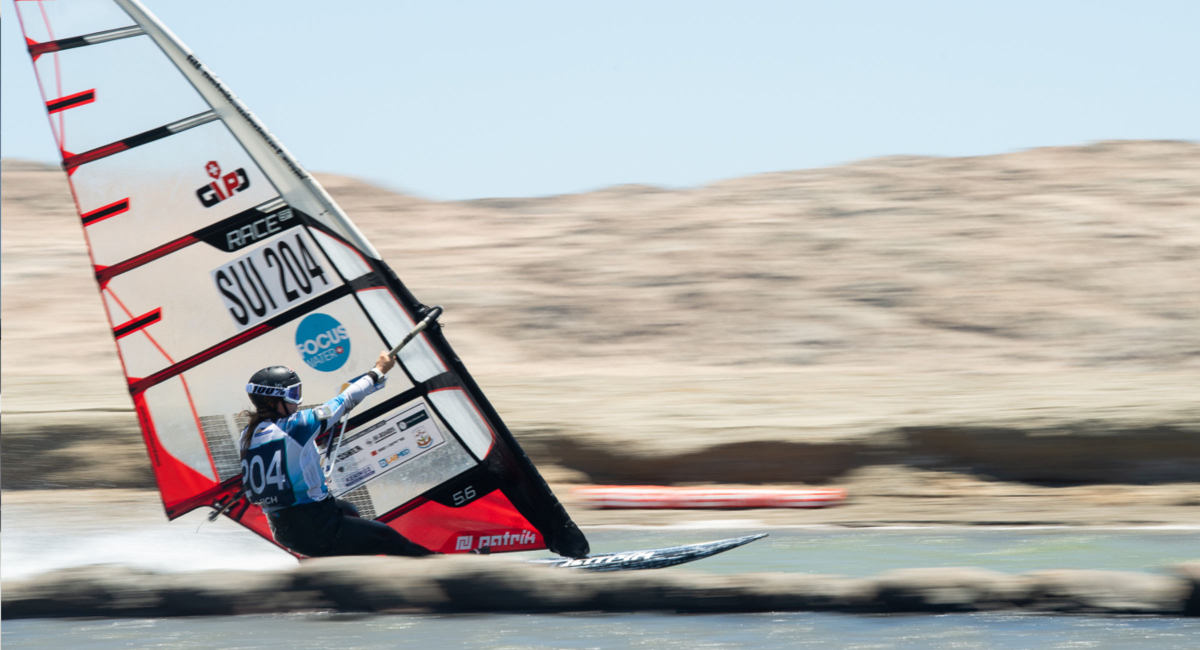
Basically, we ride the small speed boards totally overpowered because, especially in the Channel, we drop so low that we’d have far too little pressure in the sail with normal sail sizes. When we ride in France, for example, I usually go one sail size smaller than I would in the Channel because we don’t ride as low there.
When someone starts speed sailing, they shouldn’t ride overpowered at first, but rather use the sails they’d normally use. And with those, they should first test the limits. You have to ride a deep downwind course to really get fast. But that’s a different riding sensation than normal surfing.
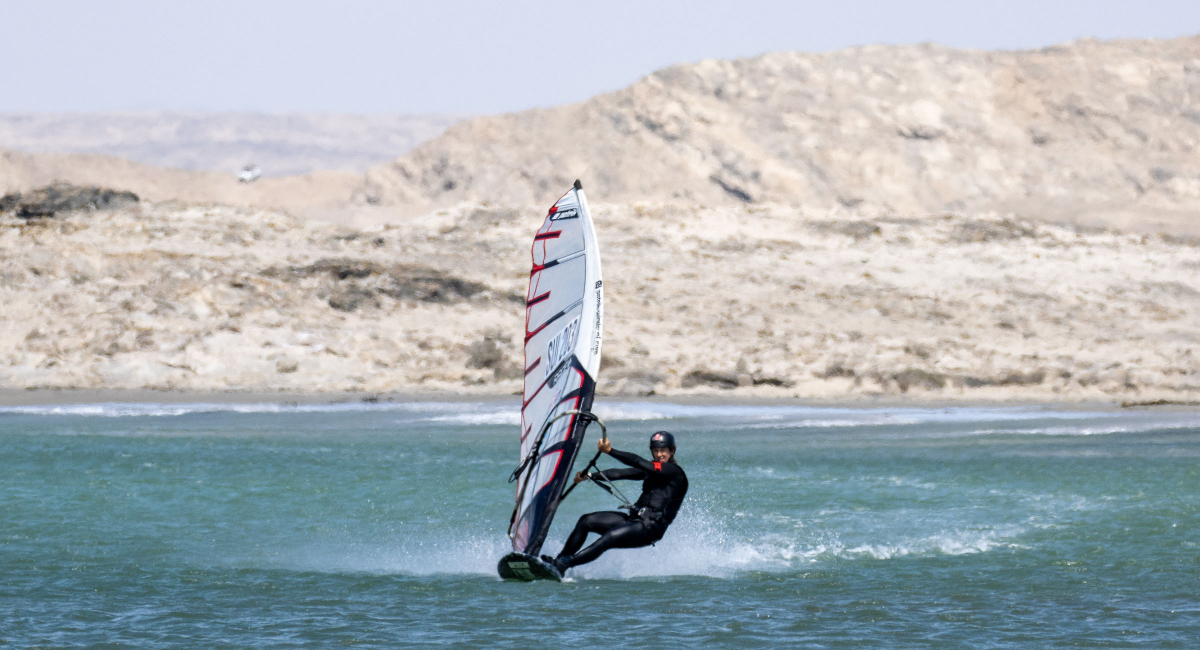
You usually head to the start overpowered and then do a slingshot to catapult yourself onto the course. At the transition from being overpowered to the actual speed run, where there’s suddenly much less pressure in the sail, things can get messy...«
What is a slingshot?
“A slingshot is when you really pull yourself out of the half-wind course and catapult yourself into the downwind course. In Lüderitz, that’s the ‘corner’ where the starting basin transitions into the course. There, you’re extremely overpowered for just a millisecond—or maybe a second—and let yourself be catapulted onto the course.
And when we train the slingshot in France, for example, where the wind usually comes from a half-wind direction, we really let ourselves be—I’ll say—catapulted out from the shore. I don’t know how else to explain it, but it’s to build even more speed and have a bit more pressure in the sail for a short time before you really go down hard. The wind then comes more or less straight from behind into the sail, and that’s actually the course that’s very fast. You really need the slingshot to get that acceleration.”
You work full-time in accounting as a payroll accountant. How do you balance your job and windsurfing?
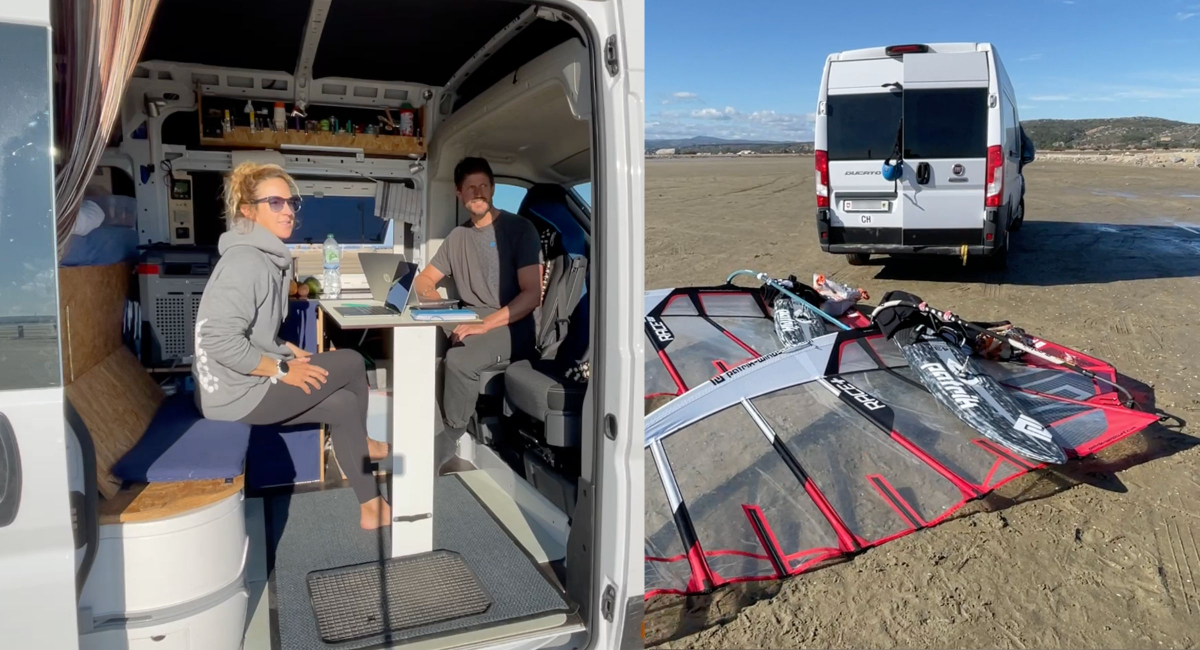
“I’m lucky that I’ve been with the same employer for ten years and can really work remotely a lot. I work full hours; my employer has a lot of trust in me and is therefore also my biggest sponsor. Otherwise, it wouldn’t be possible at all. I’m on the road 4 to 6 months a year and have the flexibility to react immediately when there’s wind in France for training.
And then we’re on the road in our converted van, where I’m actually working for my employer. I work in the mornings and evenings, except on race days. Of course, I let the office know about the race days, and it actually works out pretty well that way. You need a ton of self-discipline. I’m managing to balance it all pretty well, at least for now.”
Could you make a living solely from sponsorship?
“Making a living from windsurfing is a tough business. Speed is such a niche discipline—it’s even more of a fringe sport than windsurfing itself. I’d love to be able to make a living from it; it would be totally awesome, but unfortunately, no.”
Is there a speed record you’re determined to break?
“Before I went to Lüderitz last year, the world record was my number one goal. I also had a top speed of 50 knots in mind, because I really think it’s possible. I then fell short by 0.06 knots twice. I think a top speed of 50 knots is definitely achievable. I know that after we analyzed all the runs in detail. I believe an average of 48 knots over 500 meters would be possible, if not more.
Those 500 meters are actually a short distance, and yet it’s a very long distance because over those 500 meters, you’re so heavily dependent on the wind and the wind angle. So much can happen in those 20 or 19 seconds while you’re on the run. You need so many runs before everything finally comes together just right. I did a total of 120 runs, and it didn’t work out until the 102nd one in Lüderitz.”
Do you surf other disciplines besides speed?
“We also go into the waves, but without a sail, using a paddleboard. In windsurfing, I’ve also done slalom. But foiling isn’t really my discipline. I can do it, but I prefer it when I can feel the water more directly with the fin. One goal would have been to compete in the PWA. But since it’s all about foils now, I have to admit quite frankly that it doesn’t appeal to me at all anymore.”
January 19, 2023 © DAILY DOSE | Text: Christian Tillmanns | Fotos/Grafiken: Jaco Wolmarans, Jacques Marais | translation: DE